
其所從來者微,視之不見,聽而不聞,故似鬼神。
“Its beginnings are subtle: unseen when looked for, unheard when listened for; therefore it resembles ghosts and spirits.”
Lingshu, chapter 58, “Zei Feng” 賊風
Somewhere to return
Some experiences end in the world and continue within us. A relationship is over and the conversation still repeats itself at three in the morning, or a danger passed months ago and the body still braces at the sound of a car door in the street. When someone has died, the life imagined with them can remain unfinished for years, laid out like a table set for a meal that will not be eaten. Sometimes what persists is recognizable as sorrow or fear. Sometimes it becomes harder to name: a compulsive return, a sense of absence, an inner demand that seems to have more authority than our own intentions.
One of the oldest Chinese accounts of such persistence is political before it is medical. In the Zuozhuan, under the seventh year of Duke Zhao (535 BCE), the people of Zheng were terrified by reports that Boyou, a nobleman who had died violently, was returning to take vengeance. Zichan, the chief minister, gave Boyou’s son recognized standing, and the fear subsided. Asked why this had worked, he answered: 鬼有所歸,乃不為厲, “When a ghost has somewhere to return to, it does not become harmful.” In the same conversation he explained that people who die by violence may leave a hún and pò strong enough to cling to the living. The ghost in this account is the unfinished business of a violent death, and the remedy is a place.
The Chinese medical tradition of the thirteen ghost points gives these questions a distinctive clinical language. Associated with the physician Sun Simiao, it concerns disturbances so profound that a person’s speech, behavior, or relationship to the world could seem governed by another presence. Its inheritance includes medicine, ancestral relationships, ritual, and the cultivation of the healer. Contemporary practitioners have also drawn on it to consider the ways fear, fixation, and unresolved experience can occupy a life.
The Lingshu approaches such illness through a question about origins. In chapter 58, the emperor asks how someone can become ill when the cause escapes ordinary observation. Qibo describes a retained pathogenic influence, the movements of aversion and longing, and disturbance within blood and qi. The dialogue then considers how knowledgeable ritual specialists might effect a cure through invocation, because they knew where the illness had arisen. What seems mysterious is approached through both the person’s history and the religious world in which that history is understood.
Between these sources a clinical inquiry opens into what helps a person become available to life again. A memory may continue to matter while losing some of its authority over the present. Grief may find expression through remembrance and relationship. A person who has lived through coercion may gradually recover the capacity to feel a preference, speak it, and have it respected.
Sun Simiao and the historical inheritance
Sun Simiao was a seventh-century physician whose Beiji Qianjin Yaofang, Essential Prescriptions Worth a Thousand in Gold for Emergencies, was compiled around 652 CE. His medicine placed treatment within a wider practice of nourishing life, including daily conduct and the cultivation of the physician. In the received text of juan fourteen, which Sun devotes to the Small Intestine and its pairing with the Heart, the thirteen-site method appears under wind madness and is attributed to Bian Que. Sun is a major recorder and transmitter of this tradition; its earlier origins are less certain than that attribution might suggest.
The Qianjin anticipates a revealing response by the fifth or sixth point: the influence may speak and explain where it came from. If speech fails to emerge after several sites, the full sequence is used. Yang Jizhou’s Zhenjiu Dacheng, published in 1601, gives a different order of operations. After all thirteen sites are needled, the physician questions the patient aloud, writes down each answer with a brush, and removes the needles only when the speaking is exhausted and the disturbance has ceased.
Speech therefore matters within the historical procedure, but the physician’s question already assumes an explanation. The account is elicited within a ritual understanding of harmful influences. A contemporary practitioner concerned with agency has an additional responsibility: to leave room for the person’s own interpretation, including disagreement with the healer. Listening involves attention to both what someone says and the conditions under which they are able to say it.
The older techniques also differ sharply from a modern point chart. The Qianjin specifies fire needles at five of the sites, three cones of moxa at the eleventh, and at the thirteenth a needle passed through the tongue at its central seam, with a board laid across the corners of the mouth to keep it still. Elsewhere in the same section, a method attributed to Canggong binds both thumbs with a cord while moxa burns below the ribs, until the ghost states its name and asks to leave. Hand seals, which the text calls a secret of the ritual specialists, belong to the same setting. These features are part of the record from which later practitioners have selected and adapted.
Sun’s ethical teaching belongs beside this difficult inheritance. In his account of the sincerity of the great physician, he asks the physician to settle the mind, develop compassion, and attend to suffering without discrimination (Wilms, 2020). Compassion and coercion coexist within the historical material. We can inherit the demand for careful, generous care while taking responsibility for how treatment is offered now: with explanation, ongoing consent, and respect for the person’s limits.
Gui and the spirit of an embodied life
Guǐ 鬼 belongs to a world of the dead, ancestors, and potentially troubling presences. The category has religious meanings of its own. In clinical language, a person might also seem inhabited by an emotion, driven by an attachment, or estranged from the ordinary continuity of self. Moving between these understandings requires attention to the speaker and the context.
The two souls of the living person are written with the same component. 魂 hún and 魄 pò both carry 鬼, and the Liji describes their parting at death in the language of return: 魂氣歸于天,形魄歸于地, the hún-qi returns to Heaven and the bodily pò returns to Earth. The Suwen assigns the pò to the Lung (肺藏魄), the organ the correspondences give to autumn and to grief. In this vocabulary a ghost is something of a person that has not completed its return.
Chinese medicine offers several ways to describe the disruption of the living. In Elisabeth Rochat de la Vallée’s scholarship, shén concerns the vitality and organization of living processes as well as awareness and expression (Rochat de la Vallée, 2012). Giovanni Maciocia approaches emotional life through the Five Shen and through ordinary pattern differentiation, in which Shen, Hun, Po, Yi, and Zhi are associated with Heart, Liver, Lung, Spleen, and Kidney (Maciocia, 2009). Spirit and the condition of the body are considered together.
A useful clinical question is what has become difficult for this particular person: rest, orientation, emotional contact, imagination, nourishment, the ability to act, or the ability to remain in relationship. Several people may describe themselves as haunted while needing very different forms of care. Someone may become less visibly distressed while remaining without pleasure, initiative, or a felt connection with others, and a fuller inquiry asks whether rest is becoming restorative, whether affection can be received, and whether the person can imagine a future that includes something they want. Their language offers an opening for inquiry; their circumstances give that inquiry its direction.
Jeffrey Yuen’s teaching on the ghost points is framed as the unbinding of spirit from its attachments. His broader Daoist teaching places considerable importance on the healer’s cultivation and the possibility of changes in perception. In an interview on shamanism, he describes the body as a means of returning from altered states, with attention to physical experience helping a person remain anchored, and he observes how fear of ghosts can escalate into panic (Yuen, n.d.). His account combines a substantial spiritual worldview with concern for the person’s capacity to return to ordinary reality. In his 2002 seminar on the three spirits and seven souls, he arranges the thirteen points in four groups and follows a haunting through them, from a first sense of strangeness at the upper lip to the seal beneath the tongue (Yuen, 2005).
Unbinding, in clinical terms, can mean making more room for response. A person might begin to notice the difference between a remembered threat and a danger that requires action now, or between affection for someone and the repeated surrender of a necessary boundary. The practical question is whether an interpretation helps someone participate more freely in their life.
Lonny Jarrett, writing on trauma, places in the practitioner’s awareness a dimension of self that is “never wounded or traumatized” (Jarrett, 2025). This is a contemplative position about the nature of self. In clinical relationship, it asks the practitioner to remain attentive to possibilities that injury can obscure while giving the injury full recognition.
Possession language can frighten a patient as readily as it can console one. The choice of words is itself part of the encounter: a useful image should remain open to discussion, and the person should be able to receive care in language they can inhabit.
Fear, obsession, and the pursuit of relief
Fear can continue through anticipation. A sound, expression, place, or bodily sensation may call up alarm before a person has had time to assess the present situation. Re-experiencing, avoidance, and heightened arousal are recognized features of post-traumatic stress disorder, although responses to trauma vary considerably (National Institute of Mental Health [NIMH], n.d.-a). Someone may understand intellectually that a particular danger has passed and still find their body preparing for it.
In that situation, reassurance alone may be insufficient. The person also needs circumstances in which safety can be experienced and choices can be exercised. If coercion, violence, or instability is ongoing, practical protection remains central, and a contemplative interpretation becomes useful when it helps us attend more accurately to those conditions.
Obsession has a different texture. Attention returns to a question that seems to demand certainty: whether something terrible will happen, whether a mistake has been made, whether a thought reveals something unacceptable about the self. In obsessive-compulsive disorder, intrusive thoughts can be unwanted and distressing, while checking or other compulsions offer temporary relief, and that relief can help maintain the cycle (NIMH, n.d.-b). The content of an intrusive thought does not by itself establish a person’s intentions or character.
Here the language of spiritual contamination requires care. A practice intended to bring relief could become another demanded ritual if someone feels they must repeat it until they are certain that an invisible danger has gone. The more helpful direction is to support a workable relationship with uncertainty and access to appropriate treatment. A ritual’s meaning, the freedom to choose it, and its place in the person’s life all matter.
Addiction can organize life around a similarly urgent search for relief, though it has its own biological, behavioral, and social conditions. Cues and stress may evoke craving; repeated use and its consequences can progressively constrain choice. Effective care may include medication, behavioral treatment, recovery support, and changes in the conditions that sustain use (National Institute on Drug Abuse, n.d.).
The ghost image can convey the feeling of being pulled toward something despite knowing its cost. It becomes more useful when it leads to specific questions: what does this substance or behavior make possible for a moment, what happens when it wears off, and what other forms of support are available? A person’s dignity and belonging need to remain intact throughout that inquiry, and reliable help has to extend beyond a compelling explanation.
Dissociation can involve a different loss of contact. In depersonalization, someone may feel detached from themselves; in derealization, the surrounding world can seem unreal. These experiences occur in the dissociative subtype of PTSD and in other clinical contexts, and their assessment needs attention to the person’s whole situation.
In the treatment room, presence can begin modestly: knowing where one is, being able to speak, recognizing a preference, and having a request to pause respected. A practitioner can offer choices about posture, conversation, touch, and the direction of attention. Such choices give the person a way to participate even when deeper emotional contact feels difficult.
The physiology of learning safety
Fear-extinction research provides a more precise account of one way the past can retain its influence. In laboratory learning, a cue acquires the capacity to predict an aversive event. During extinction, the cue is encountered without the expected outcome. Mark Bouton’s account emphasizes the development of new, context-sensitive learning: the earlier association remains available even as a different response is acquired, which helps explain why fear may return after time has passed or in another setting (Bouton, 2004).
The distinction has a humane implication. A returning response can be understood as part of the conditions under which learning is retrieved, and it need not be taken as evidence that every previous improvement was false. The question becomes how new experience can be made available across the rooms, streets, and hours in which a person actually lives.
The endocannabinoid system participates in this learning. Giovanni Marsicano and colleagues found that mice lacking the CB1 cannabinoid receptor learned a tone-shock association normally but were strongly impaired in extinguishing it, and that extinction training raised endocannabinoid levels in the basolateral amygdala, a central site of fear learning (Marsicano et al., 2002).
Iva Dincheva and colleagues later examined a common human variant of the gene for FAAH, the enzyme that breaks down the endocannabinoid anandamide. Mice engineered to carry the variant had higher forebrain anandamide, stronger coupling between prefrontal cortex and amygdala, and less freezing in late extinction trials. Among forty people, the eighteen who carried the variant showed lower skin-conductance responses during late extinction than the twenty-two who did not (Dincheva et al., 2015).
Acupuncture research offers a separate clinical finding. Michael Hollifield and colleagues randomized ninety-three combat veterans with PTSD to verum acupuncture or a minimal-needling sham. Symptom severity fell more with verum treatment, and fear-potentiated startle during extinction fell with verum and not with sham (Hollifield et al., 2024). The prescription was not the thirteen ghost points, and the trial did not measure endocannabinoid signaling.
Bouton’s account carries the image with which this teaching began. Extinction leaves the first association where it was and lays a second beside it, and which of the two a given room calls up depends on context. The earlier learning is given a place rather than erased, and the clinical work lies in multiplying the places where the newer response can be found, so that a person grows able to meet a reminder, remain oriented, and find a response that fits the present. Whether acupuncture acts through endocannabinoid signaling in human fear extinction has not been measured, and it is a question worth pursuing.
Grief, voices, and the place of the dead
Grief changes the world of ordinary actions. A familiar hour arrives without the person who gave it its shape. A task once shared becomes solitary. Remembrance can be painful, comforting, or both, and a sense of the deceased person’s presence may accompany it.
In W. Dewi Rees’s 1971 study of 293 widowed people in a community in mid-Wales, almost half reported experiences classified as hallucinations or illusions of their deceased spouse, often lasting years and rarely mentioned to anyone (Rees, 1971). The category included more than seeing the person. Rees understood many of these experiences as normal and helpful accompaniments of widowhood. Their existence invites careful inquiry into meaning and impact before a clinical judgment is made.
Zichan’s remedy belongs here as well. What quieted Zheng was a recognized place for the dead man’s line among the living, and its contemporary resonance lies in the question of belonging. A death changes relationships among the living as well as the relationship with the person who has died. Shared remembrance, a meal, a place for photographs, care for a surviving relative, or work continued in someone’s name may help express what remains, and each can give love a form within a changed life.
The distinction between love and compulsion becomes important here. Continuing to love someone can coexist with new relationships and responsibilities. Remembering a relationship can include gratitude, regret, anger, and tenderness; being governed by it may narrow the present until every new encounter is measured against the old one. Suffering may deepen when remembrance becomes the only permitted activity, or when renewed interest in life feels like betrayal. For prolonged grief disorder in adults, the American Psychiatric Association sets the threshold at twelve months after the death, with grief that exceeds the expectations of the person’s culture and context and impairs daily life (American Psychiatric Association, n.d.).
Voices also require attention to their particular context. Tanya Luhrmann and colleagues interviewed twenty people with psychosis at each of three sites, in the United States, India, and Ghana. The American participants more often described violent voices and spoke of them as symptoms of illness, while participants in India and Ghana more often described relationships with their voices, some of them playful or companionable (Luhrmann et al., 2015). Cultural meanings and individual accounts shape the experience itself.
The World Health Organization’s ICD-11 requirements for possession trance disorder distinguish unwanted, involuntary experiences associated with significant distress or impairment from accepted collective cultural or religious practice, and the assessment also considers substance, medical, and sleep-related explanations (World Health Organization, 2019).
For a person distressed by voices or unusual perceptions, care begins with what is happening, how frightening or commanding the experience is, whether sleep and daily functioning are affected, and what support is available. Medical and mental health assessment can help clarify contributing conditions. Experiences involving immediate danger require prompt help. Within that care, a practitioner can respect spiritual language while leaving explanations open and maintaining attention to the person’s safety and choices.
In Ayurveda: discernment and integrity
An Ayurvedic comparison brings a more difficult inheritance into view. Caraka’s chapter on unmāda, Nidāna Sthāna 7, recognizes forms of madness arising from the doṣas and an exogenous (āgantu) form attributed to gods, sages, ancestors, gandharvas, yakṣas, rākṣasas, and piśācas. Ātreya Punarvasu names prajñāparādha, often translated as an error or transgression of discernment, as its cause (7.10), and the remedies listed for it include mantra, herbs, gems, auspicious rites, offerings, homa, vows, penance, and fasting (7.16). Verse 19 states the principle: naiva devā na gandharvā na piśācā na rākṣasāḥ / na cānye svayam akliṣṭam upakliśnanti mānavam, “neither gods nor gandharvas nor piśācas nor rākṣasas, nor any others, afflict a person who has not first been afflicted by himself.” This is an explanation of action, consequence, and responsibility within the text’s medical and religious world.
A contemporary reading has to decide how that inheritance enters care. We can attend to habits, decisions, and forms of conduct that sustain suffering while also recognizing coercion, illness, deprivation, and the effects of what other people have done. Responsibility for violence belongs to those who commit it. A person’s symptoms provide no measure of their moral or spiritual worth. Beneficial action becomes meaningful through the choices that are actually available, sometimes with considerable support.
Integrity can then be understood as a developing relationship among what we feel, know, say, and do. It may have been disrupted through betrayal, through having to conceal oneself to remain safe, or through participation in events that violated deeply held values. Moral injury can involve guilt, shame, anger, and loss of trust after acts committed, witnessed, or not prevented that conflict with those values (National Center for PTSD, n.d.).
The appropriate response depends on where responsibility lies. Someone who caused harm may need acknowledgment and repair. Someone who was harmed may need support in returning responsibility to the person who caused it. Someone who survived an impossible choice may need a fuller, less punitive understanding of the conditions in which it was made.
In this sense, restoring integrity is practical: a boundary spoken and then upheld, an apology that names what happened without demanding forgiveness, care that is finally accepted, a commitment made small enough to keep. The word describes a growing capacity for coherence within a life, supported by relationships and conditions that make honest action possible.
Presence, consent, and a practice of return
In the Zhenjiu Dacheng, Yang Jizhou asks physician and patient each to settle their own spirit before needling proceeds, and says that if the patient detests the needle one cannot speak of treatment. His instruction appears among vermilion talismans, incantations, and ritual preparation. The Suwen also attends to the patient’s disposition and recognizes the futility of treating someone who will not permit treatment. These passages offer historical precedents for attention to willingness and readiness. Contemporary informed consent adds explicit responsibilities concerning explanation, alternatives, and the person’s continuing freedom to stop.
A treatment encounter can make those responsibilities tangible. The practitioner explains what is proposed, invites questions, and agrees on how the person can pause. The patient can choose language for the experience without having to adopt the practitioner’s cosmology. Predictability, collaboration, and voice and choice are central to contemporary trauma-informed care (Substance Abuse and Mental Health Services Administration, 2014), and they give a person ways to remain involved when treatment brings unfamiliar sensations or feelings.
The same care applies with particular force at the eleventh site, the perineum, where the classical method was moxibustion. Lonny Jarrett discusses Huiyin in relation to sexual trauma (Jarrett, 1995, pp. 147–148). An intimate anatomical site or a symbolic point name cannot establish a history of abuse, and any proposed treatment there requires a clear explanation and specific consent.
Two trials of selected ghost points have been published, one an open-label adjunct to fluoxetine in depression and one a sham-controlled trial in insomnia with depressive symptoms; both are summarized in the research notes below. For addiction, distressing voices, dissociation, and intrusive thoughts, appropriate assessment and condition-specific care remain central.
Change is best followed in the person’s life: sleep, daily functioning, relationships, distress, and the capacity to make and sustain choices. A vivid image, tears, or an intense sensation can matter, but benefit is assessed through what follows. The person and practitioner can decide together which changes are meaningful and how they will recognize them.
The practice: returning to the room
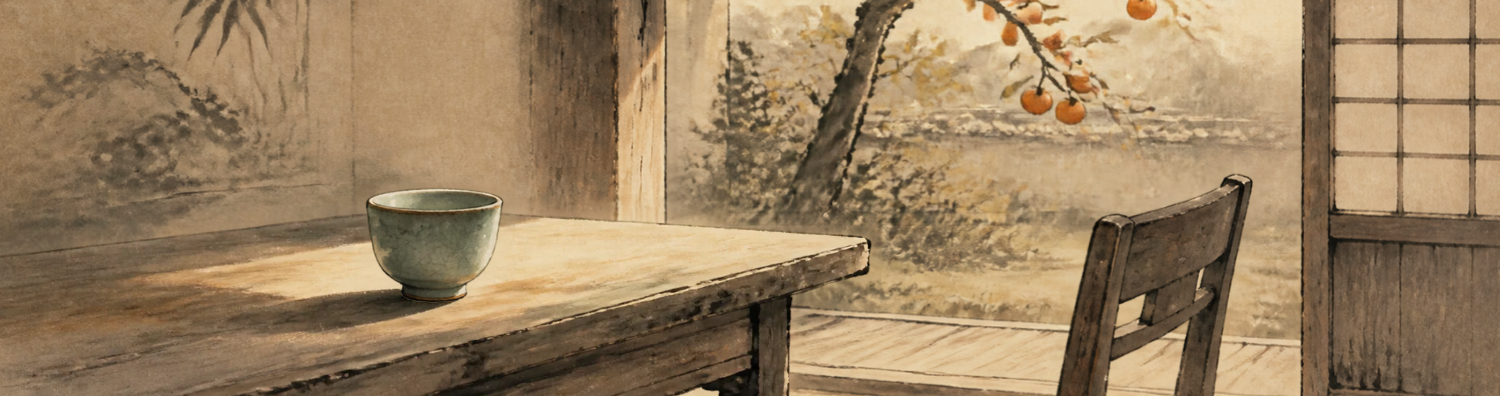
Give this two or three minutes, in a place that feels sufficiently safe and a position that allows ease. Keep the eyes open. Take in the room or the landscape: the quality of the light, the distance to the nearest doorway, the shape of one nearby object. Let attention rest on something ordinary and comfortable to look at, a cup, a window frame, the grain of a table.
Find one point of physical support, the chair beneath you or a hand resting on cloth. Leave the breath at its own pace. At any point you may shift attention, move, or stop; the practice is an exercise of choice within a small, manageable field.
When something demanding appears, a memory, an urge, a sorrow, an argument, give it a plain name if naming helps. Then find something else that is present: a sound in the room, an area of relative comfort, another person within reach. Let attention move between the demanding experience and these ordinary features, at a pace that stays manageable.
Finally, ask what would be useful next. It might be a glass of water, a meal, a short walk, a message to someone trustworthy, or an appointment for support. If grief is present, it might be a few minutes with a photograph, or a memory told to someone who knew the person. Choose one action small enough to carry out and carry it out. Then return to one ordinary activity and notice how much choice is available in the way you meet it.
A place among the living
Zichan gave Boyou’s son recognized standing in Zheng, and the hauntings stopped; asked to explain, he spoke of a place to return. Sun Simiao’s method, read beside him, waits for speech, expecting the influence by the fifth or sixth point to say where it came from, and Yang Jizhou’s physician writes each answer down with a brush before the needles are withdrawn. In both accounts what persists has an origin that can be named and a place to which it can be sent, and the laboratory account of extinction, in which the first association remains while new learning bound to context decides which response a given room calls up, describes a nervous system that keeps its history in a similar way. The clinical sign of that kind of change is ordinary and observable: a reminder arrives, the person remains in the room, and they can say what they would like to do next.
Reference: the thirteen sites in a common received sequence
The chart gives modern surface locations for study. GV/DU and CV/REN are alternative channel abbreviations. WHO locations use B-cun for proportional body measurements and F-cun for finger measurements. Haiquan is separately sourced as an extra point. These descriptions provide no needling instructions; the tongue, perineum, and upper neck particularly require professional anatomical knowledge and appropriate consent.
| No. | Modern point | Ghost name | Surface location |
|---|---|---|---|
| 1 | GV26 Shuigou or Renzhong | Guigong 鬼宮, Ghost Palace | Philtrum midpoint; WHO alternative: upper-third/lower-two-thirds junction. |
| 2 | LU11 Shaoshang | Guixin 鬼信, Ghost Faith or Trust | 0.1 F-cun proximal-lateral to the radial thumbnail corner. |
| 3 | SP1 Yinbai | Guilei 鬼壘, Ghost Fortress | 0.1 F-cun proximal-medial to the medial great-toenail corner. |
| 4 | PC7 Daling | Guixin 鬼心, Ghost Heart | Palmar wrist crease, between palmaris longus and flexor carpi radialis tendons. |
| 5 | BL62 Shenmai | Guilu 鬼路, Ghost Road | Depression between the lateral malleolus’s lower border and calcaneus. |
| 6 | GV16 Fengfu | Guizhen 鬼枕, Ghost Pillow | Midline depression below the external occipital protuberance, between trapezius muscles. |
| 7 | ST6 Jiache | Guichuang 鬼床, Ghost Bed | One middle-finger breadth anterosuperior to the mandibular angle, over masseter. |
| 8 | CV24 Chengjiang | Guishi 鬼市, Ghost Market | Central depression of the mentolabial groove. |
| 9 | PC8 Laogong | Guiku 鬼窟, Ghost Cave (Dacheng); Guilu 鬼路, Ghost Road (Qianjin) | Palm, between second/third metacarpals, proximal to knuckles; WHO alternative: third/fourth. |
| 10 | GV23 Shangxing | Guitang 鬼堂, Ghost Hall | Head midline, 1 B-cun above the anterior hairline. |
| 11 | CV1 Huiyin | Guicang 鬼藏, Ghost Store | Perineal midpoint between anus and posterior scrotal border or posterior labial commissure. |
| 12 | LI11 Quchi | Guichen 鬼臣, Ghost Minister (Qianjin); Guitui 鬼腿, Ghost Leg (Dacheng) | With elbow flexed, midway between LU5 and the lateral humeral epicondyle. |
| 13 | Haiquan EX-HN11, a modern identification of Guifeng | Guifeng 鬼封, Ghost Seal | Midpoint of the lingual frenulum beneath the tongue. |
Point names and aliases follow the received tradition; anatomical locations follow the WHO standard (World Health Organization, 2008), with Haiquan separately documented. The two Guixin names use different characters: 信, faith or trust, at LU11, and 心, heart, at PC7.
The Qianjin‘s fourth-point gloss identifies Taiyuan rather than Daling. Its ninth site repeats the name Ghost Road, places the point three cun above the wrist crease between the tendons, and glosses it as Laogong. The eleventh site distinguishes male and female locations. The thirteenth describes the tongue without naming Haiquan. In the Dacheng, the eleventh-site song specifies moxa while the accompanying key describes needling. These differences should remain visible when comparing textual versions. Historical diān and kuáng likewise require their own context rather than a one-to-one assignment to present-day diagnoses.
Clinical research notes
Wang and colleagues (2022) randomized 160 people with mild to moderate depression to ghost-point acupuncture plus fluoxetine or fluoxetine alone, with needling five times weekly. The acupuncture arm also used Governing Vessel points, the trial had no sham procedure, and blinding was not reported. Scores did not differ at four weeks; at eight weeks the combined group had lower depression scores and a higher response rate (51.25% against 36.25%). Table 7 gives adverse-reaction rates of 5.00% and 16.25%, and a discussion paragraph gives different figures without clear attribution.
Tao and colleagues (2025) randomized eighty people with chronic insomnia and depressive symptoms to ghost-point acupuncture or sham acupuncture, twelve sessions over four weeks, in a single-blind trial registered as ChiCTR2400082104. Insomnia severity and depressive symptoms improved more with active treatment.
Hollifield and colleagues (2024) studied a different acupuncture prescription in combat veterans with PTSD; its clinical and fear-extinction results belong to that protocol. The National Center for Complementary and Integrative Health (2024) describes inconsistent evidence for acupuncture in substance-use disorders, with some possible adjunctive benefit for withdrawal, craving, and anxiety. None of these trials establishes ghost-point treatment for dissociative disorders, intrusive thoughts, or hearing voices.
References
Classical sources
Caraka Saṃhitā. Nidāna Sthāna 7, Unmāda Nidāna, verses 10, 16, 19.
Huangdi Neijing Lingshu 黃帝內經靈樞. Chapter 58, “Zei Feng” 賊風.
Huangdi Neijing Suwen 黃帝內經素問. Chapter 11, “Wuzang Bie Lun” 五臟別論; chapter 23, “Xuanming Wuqi” 宣明五氣.
Liji 禮記. “Jiao Te Sheng” 郊特牲.
Sun Simiao 孫思邈. (c. 652). Beiji Qianjin Yaofang 備急千金要方. Juan 14, “Feng Dian” 風癲, “Zhenjiu Fa” 針灸法.
Yang Jizhou 楊繼洲. (1601). Zhenjiu Dacheng 針灸大成. “Zhen Xie Miyao” 針邪秘要 and “Sun Zhenren Zhen Shisan Gui Xue Ge” 孫真人針十三鬼穴歌.
Zuozhuan 左傳. Duke Zhao, year 7.
Modern sources
American Psychiatric Association. (n.d.). Prolonged grief disorder.
Bouton, M. E. (2004). Context and behavioral processes in extinction. Learning & Memory, 11(5), 485–494. https://doi.org/10.1101/lm.78804
Dincheva, I., Drysdale, A. T., Hartley, C. A., Johnson, D. C., Jing, D., King, E. C., Ra, S., Gray, J. M., Yang, R., DeGruccio, A. M., Huang, C., Cravatt, B. F., Glatt, C. E., Hill, M. N., Casey, B. J., & Lee, F. S. (2015). FAAH genetic variation enhances fronto-amygdala function in mouse and human. Nature Communications, 6, Article 6395. https://doi.org/10.1038/ncomms7395
Hollifield, M., et al. (2024). Acupuncture for combat-related posttraumatic stress disorder: A randomized clinical trial. JAMA Psychiatry, 81(6), 545–554. https://doi.org/10.1001/jamapsychiatry.2023.5651
Jarrett, L. S. (1995). Chinese medicine and the betrayal of intimacy, Part II. American Journal of Acupuncture, 23(2), 123–151.
Jarrett, L. S. (2025). Untying the knot [Course description]. lonnyjarrett.com
Luhrmann, T. M., Padmavati, R., Tharoor, H., & Osei, A. (2015). Differences in voice-hearing experiences of people with psychosis in the USA, India and Ghana. British Journal of Psychiatry, 206(1), 41–44. https://doi.org/10.1192/bjp.bp.113.139048
Maciocia, G. (2009). The psyche in Chinese medicine. Churchill Livingstone.
Marsicano, G., et al. (2002). The endogenous cannabinoid system controls extinction of aversive memories. Nature, 418(6897), 530–534. https://doi.org/10.1038/nature00839
National Center for Complementary and Integrative Health. (2024). Psychological and physical approaches for substance use disorders.
National Center for PTSD. (n.d.). Moral injury. U.S. Department of Veterans Affairs.
National Institute of Mental Health. (n.d.-a). Post-traumatic stress disorder.
National Institute of Mental Health. (n.d.-b). Obsessive-compulsive disorder.
National Institute on Drug Abuse. (n.d.). Drugs, brains, and behavior: The science of addiction.
Rees, W. D. (1971). The hallucinations of widowhood. British Medical Journal, 4(5778), 37–41. https://doi.org/10.1136/bmj.4.5778.37
Rochat de la Vallée, E. (2012). Shen (spirit, soul) in Chinese religion and medicine [Charles Strong Trust Lecture].
Substance Abuse and Mental Health Services Administration. (2014). SAMHSA’s concept of trauma and guidance for a trauma-informed approach (HHS Publication No. SMA 14-4884).
Tao, Y., Xu, J., Liu, Z., Huang, Z., Wang, F., Xia, M., & Chen, Y. (2025). Efficacy of acupuncture at “ghost points” in the treatment for chronic insomnia with depressive symptoms: A randomized controlled trial. Journal of Psychosomatic Research, 196, Article 112335. https://doi.org/10.1016/j.jpsychores.2025.112335
Wang, Y., Huang, Y.-W., Ablikim, D., Lu, Q., Zhang, A.-J., Dong, Y.-Q., Zeng, F.-C., Xu, J.-H., Wang, W., & Hu, Z.-H. (2022). Efficacy of acupuncture at ghost points combined with fluoxetine in treating depression: A randomized study. World Journal of Clinical Cases, 10(3), 929–938. https://doi.org/10.12998/wjcc.v10.i3.929
Wilms, S. (2020). A heart full of great compassion.
World Health Organization. (2008). WHO standard acupuncture point locations in the Western Pacific Region. WHO Regional Office for the Western Pacific.
World Health Organization. (2019). International classification of diseases (11th ed.), 6B63 Possession trance disorder.
Yuen, J. C. (2005). Three spirits & seven souls (S. Howard, Ed.) [Transcript of seminar, New England School of Acupuncture, June 29–30, 2002].
Yuen, J. C. (n.d.). [Interview on shamanism].